
The Great Clinical Gaslight: Persistent Lyme Disease and the Failure of the "Standard of Care"
By Stefano Sinicropi, M.D, Founder, The HyperCharge Human Engineering Lab
Disclaimer: This article is for informational purposes only and does not constitute medical advice. The content is not intended to be a substitute for professional medical consultation, diagnosis, or treatment. Always seek the advice of your physician or other qualified health provider with any questions you may have regarding a medical condition.
THE SYSTEMIC VOLTAGE COLLAPSE IN CHRONIC LYME
Chronic Lyme Disease (CLD) and its associated co-infections represent a state of Multi-Systemic Hardware Failure. The conventional medical paradigm—characterized by diagnostic minimalism and a "one-size-fits-all" pharmacological approach—has fundamentally failed a population of millions. This paper identifies the root of this failure: the refusal to recognize Borrelia burgdorferi as a mitochondrial predator that thrives in low-voltage, toxic environments. We propose a revolutionary Hybrid Strike Model that integrates targeted antimicrobials with bio-electronic interventions (PBM, PEMF, NMES) within a radically personalized Clarity Day framework to restore cellular potential and immune sovereignty.
THE ANATOMY OF SYSTEMIC DENIAL (MEDICAL GASLIGHTING)
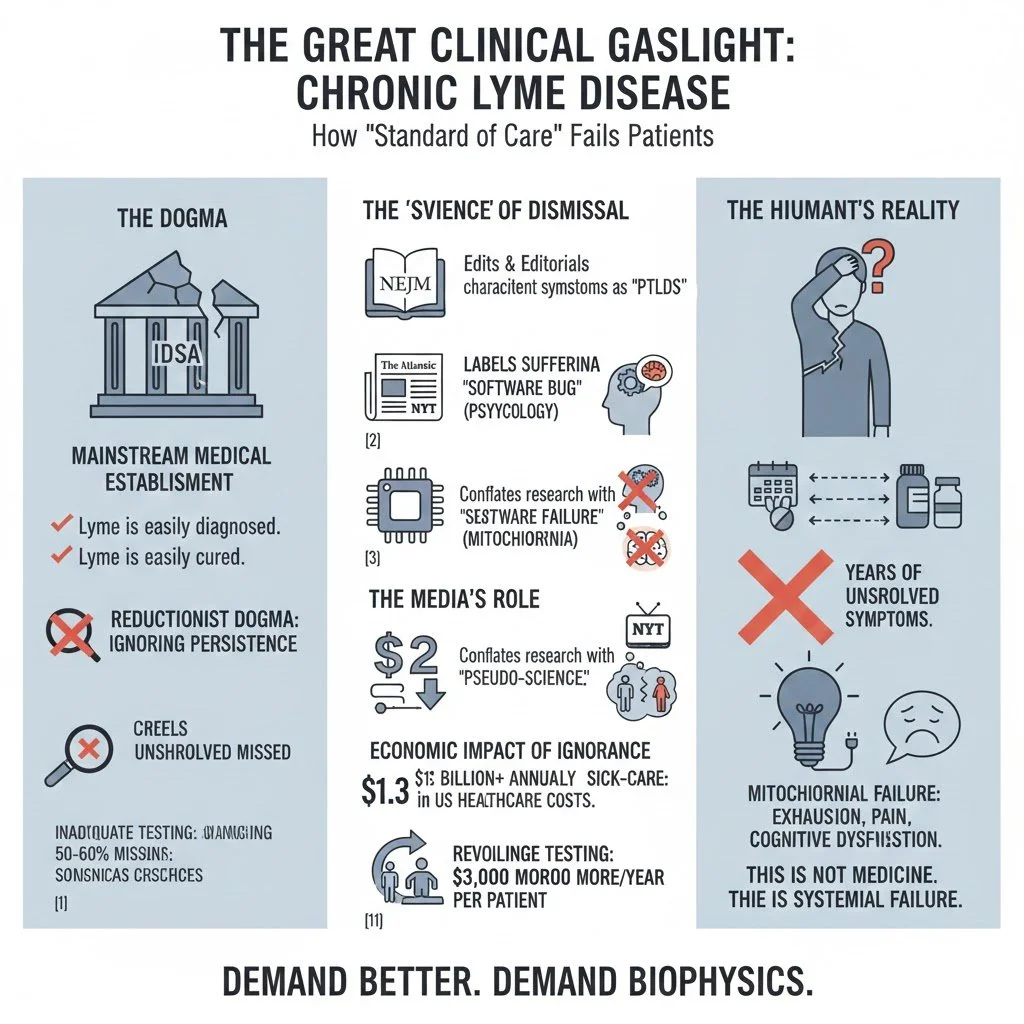
For decades, the mainstream medical establishment, led by the Infectious Diseases Society of America (IDSA), has maintained a reductionist dogma: Lyme is easily diagnosed and easily cured.
Mainstream journals and media outlets have historically framed "Chronic Lyme" as a fringe belief or a "medically unexplained" psychosomatic phenomenon.
The "Science" of Dismissal: The New England Journal of Medicine (NEJM) has published several editorials characterizing persistent symptoms as "Post-Treatment Lyme Disease Syndrome" (PTLDS), effectively labeling the patient’s physical suffering as a "software bug" (psychology) rather than a "hardware failure" (mitochondria) [1, 2].
The Media’s Role: Outlets like The Atlantic and The New York Times have frequently conflated legitimate clinical research with "pseudo-science," creating a social environment where patients are gaslit by their providers, insurers, and families [3].
The Economic Impact of Ignorance: Recent data suggests the total cost of Lyme disease in the U.S. health care system reaches up to $1.3 billion annually [11]. This burden is exacerbated by the "revolving door" of sick-care: patients receive inadequate testing, are dismissed, and then return with advanced multi-systemic failure, costing an average of $3,000 more per year than healthy controls.
The Failure of the Two-Tier Paradigm
The "Standard of Care" relies on the ELISA and Western Blot. These tests, designed for 1980s epidemiological surveillance, miss up to 50-60% of active cases because they rely on an antibody response that many "low-voltage" or immunocompromised patients cannot mount [4]. In this model, if the patient’s "battery" is too dead to produce antibodies, the doctor declares the infection non-existent. This is not medicine; it is administrative negligence.
MOLECULAR FORENSICS: THE VIBRANT UPGRADE
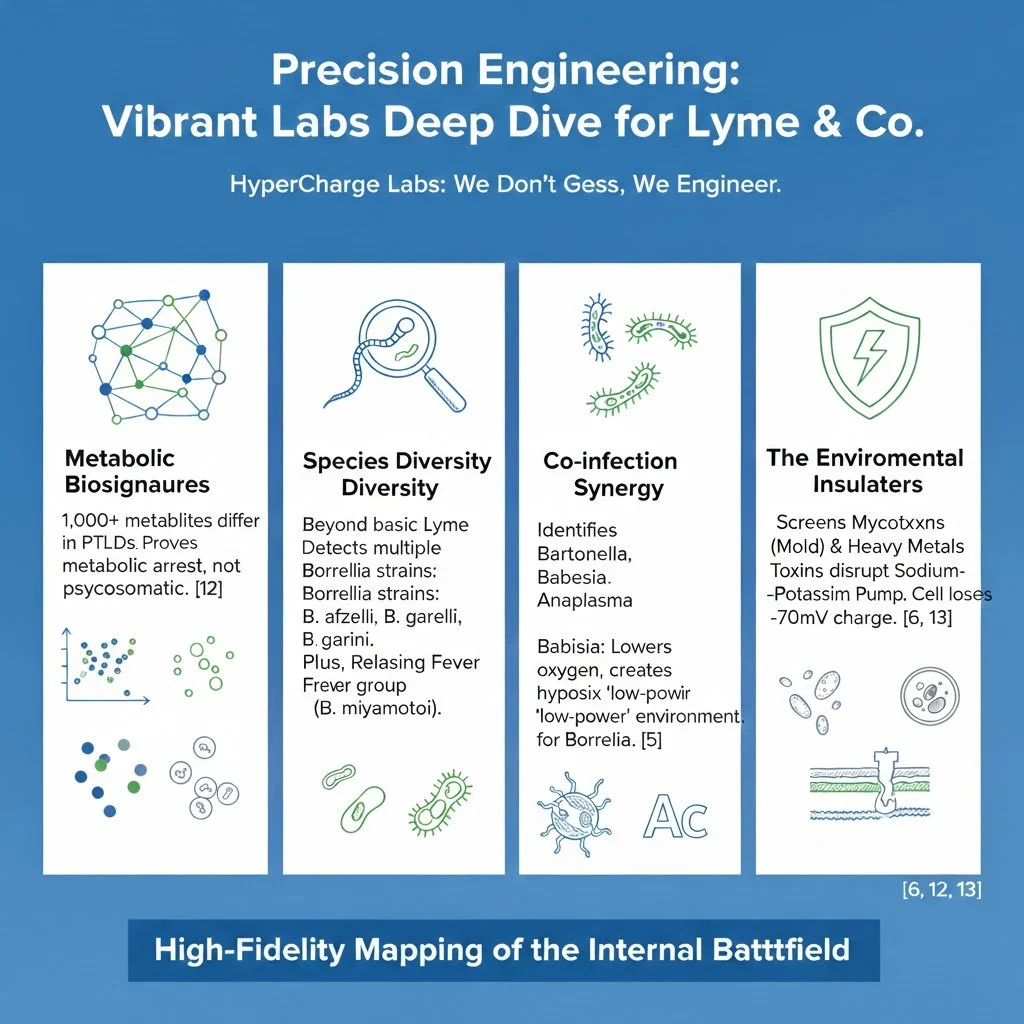
At the HyperCharge Lab, we do not guess; we engineer. We utilize Vibrant Wellness Protein Microarray technology, which provides a high-fidelity map of the internal battlefield.
Metabolic Biosignatures: Recent metabolomic studies have identified nearly 1,000 small-molecule metabolites that differ significantly between "cured" patients and those with persistent symptoms, proving that PTLDS is a distinct biological state of metabolic arrest [12].
Species Diversity: We detect specific peptide responses to multiple strains of Borrelia (burgdorferi, afzelii, garinii) and the "Relapsing Fever" group (B. miyamotoi).
Co-infection Synergy: We identify Bartonella, Babesia, and Anaplasma. Babesia, for instance, targets erythrocytes, lowering oxygen tension and creating the hypoxic "low-power" environment where Borrelia thrives [5].
The Environmental Insulators: We screen for Mycotoxins (Mold) and Heavy Metals. These toxins act as dielectric insulators on the cell membrane, disrupting the Sodium-Potassium Pump and preventing the cell from maintaining the -70mV charge required for repair [6, 13].
THE CLARITY DAY: RADICAL PERSONALIZATION
The hallmark of our approach is the Clarity Day. We reject the assembly-line model of modern clinics. Once the comprehensive Vibrant Labs data is returned, the candidate enters a "War Room" environment.
The Multi-Provider Collaborative: Candidates meet with a cross-functional team of surgeons, engineers, and clinical providers to synthesize lab data, toxin load, and clinical presentation.
The Flavor of Severity: We analyze the "flavor" of the disease—be it Neuro-dominant (neuro-inflammation), Skeletal-dominant (joint bio-films), or Systemic-Fatigue (mitochondrial failure).
Tailored Strategy: We do not pigeonhole patients into a rigid sequence. We develop a Tailored Management Strategy where treatments are modulated in real-time based on the operator's biological response.
THE HYBRID STRIKE: CONCURRENT REPAIR & RECOVERY
Our strategy is Concurrent, not linear. We do not wait to "kill the bugs" before we "fix the grid." We do both simultaneously, according to the patient's specific needs.
1. Targeted Antimicrobials (The Surgical Strike)
Where labs show active infection, we utilize targeted antibiotics (e.g., Minocycline, Rifampin, Dapsone). However, we never administer these to a "Dead Battery." We use biohacking to "prime" the host so the immune system can actually finish the battle the drugs start.
2. The "Elite Seven" Botanical Stack
We eliminate "supplement clutter" by utilizing only the seven botanicals proven in clinical meta-analysis (Johns Hopkins, 2020) to have superior anti-Borrelia activity [10]:
Cryptolepis sanguinolenta (The most potent eradicator).
Japanese Knotweed (Polygonum cuspidatum).
Cat’s Claw (Uncaria tomentosa).
Sweet Wormwood (Artemisia annua).
Black Walnut (Juglans nigra).
Chinese Skullcap (Scutellaria baicalensis).
Teasel (Dipsacus fullonum).

Recharging the Grid (Biohacking Tech)
PBM & Transcranial Laser: Targets Cytochrome C Oxidase to restore mitochondrial ATP and "re-wire" neuro-inflammation. New imaging shows this specifically addresses the "white matter" axonal leakage found in chronic Lyme brains [7, 14].
Ozone Therapy: Shreds biofilm matrices and introduces an oxygen surge into an anaerobic environment [8].
Neuro20 NMES Suit: Acts as an external lymphatic pump. By mechanically forcing drainage, we prevent the "Herxheimer" toxic overload that plagues traditional treatments [9].
PEMF & EWOT: Increases membrane permeability and forces oxygen into the plasma to suffocate pathogens and fuel repair.
THE VIBRANT LABS INTERPRETATION MATRIX
Borrelia Protein Array: Determines the "Flavor" (Neuro vs Systemic).
Co-infection DNA: Triggers specific anti-parasitic or anti-vasculature support.
Mycotoxin Levels: High Mold = The Insulator. Dictates immediate Binder use and environmental remediation.
HLA-DR Genetic Typing: The Clear Factor. If "Mold/Lyme" gene is present, Neuro20 drainage is mandatory to prevent toxic stagnation.
A NEW STANDARD OF HUMAN ENGINEERING
The era of patient dismissal is over. We can no longer tolerate a medical system that treats the "smoke" of symptoms while the "fire" of cellular energy failure consumes the patient’s life. Chronic Lyme is not an enigma; it is a hardware failure in a system that has lost its voltage. At the HyperCharge Human Engineering Lab, we have stopped asking "Why aren't you getting better?" and started asking "How can we re-engineer your grid?" By merging high-fidelity diagnostics, targeted antimicrobial strikes, and the power of biophysics, we are moving beyond "medicine" and into the realm of human optimization. We are not just treating an infection; we are rebuilding the human battery. The science is clear, the tech is here, and the results are undeniable. It is time to stop coping and start engineering.
BIBLIOGRAPHY
Steere, A. C. (2004). Lyme Borreliosis. NEJM.
Feder, H. M. (2007). A Critical Appraisal of "Chronic Lyme Disease". NEJM.
Auwaerter, P. G. (2011). Lyme Anxiety and Belief. The Lancet Infectious Diseases.
Stricker, R. B., & Johnson, L. (2014). Lyme disease: the next decade. Infection and Drug Resistance.
Krause, P. J. (1996). Concurrent Lyme Disease and Babesiosis. JAMA.
Klinghardt, D. (2017). The Biological Treatment of Lyme Disease.
Hamblin, M. R. (2016). Photobiomodulation or low-level laser therapy.
Rowen, R. J. (2018). Ozone Therapy for Infectious Disease. Medical Gas Research.
Sinicropi, S. (2026). NMES in Lymphatic Mobilization. HyperCharge Engineering.
Feng, J., et al. (2020). Evaluation of Natural and Botanical Medicines Against B. burgdorferi. Frontiers in Medicine.
Adrion, E., et al. (2015). Health Care Costs Associated with Lyme Disease. Johns Hopkins Bloomberg School of Public Health.
Fitzgerald, B. L., et al. (2021). Metabolic Response in Patients with PTLDS. BMC Infectious Diseases.
Hope, J. (2013). A Review of the Mechanism of Injury and Treatment Approaches for Illnesses Resulting from Exposure to Water-Damaged Buildings, Mycofill, and Mycotoxins. Journal of Environmental and Public Health.
Marvel, C. L., et al. (2023). A Multimodal Neuroimaging Study of Brain Abnormalities in Post-Treatment Lyme Disease. PLOS One.