
The Invisible Epidemic: Why Water Damage is the Most Overlooked Cause of Chronic Illness
By Dr. Stefano Sinicropi, MDFounder, The HyperCharge Human Engineering Lab
Disclaimer: This blog is for informational purposes only and does not constitute medical advice. The content is not intended to be a substitute for professional medical consultation, diagnosis, or treatment. Always seek the advice of your physician or other qualified health provider with any questions you may have regarding a medical condition.
KEY TAKEAWAYS (EXECUTIVE SUMMARY)
Definition:Water-Damaged Building Syndrome (WDB) is a systemic inflammatory condition caused by exposure to the "biotoxin soup" (mycotoxins, endotoxins, VOCs) found in wet infrastructure.
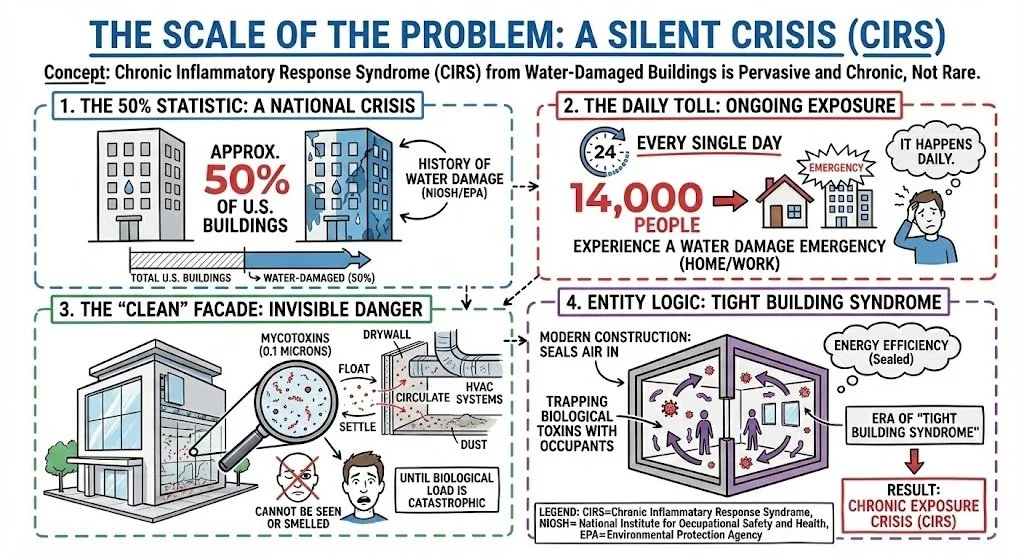
The Scale: Approximately 50% of US buildings have a history of water damage, creating a widespread, silent health crisis.
The Diagnostic Failure: Standard "Air Spore Traps" miss 99% of toxic particulate. Forensic DNA Analysis (MSQPCR) is the only medical-grade standard for assessment.
The Solution: Healing requires a "Clean Air First" approach. Patients cannot recover in the environment that made them sick.
THE SCALE OF THE PROBLEM: A SILENT CRISIS
The term "Mold Illness" is a misnomer. It suggests a rare, acute reaction. The reality is a pervasive, chronic exposure crisis known clinically as Chronic Inflammatory Response Syndrome (CIRS) acquired from water-damaged buildings.
The 50% Statistic: According to the National Institute for Occupational Safety and Health (NIOSH) and the EPA, approximately 50% of all buildings in the United States have a history of water damage.
The Daily Toll: Every single day, 14,000 people in the U.S. experience a water damage emergency at home or work.
The "Clean" Facade:Most dangerous exposure occurs in buildings that look clean. Mycotoxins are 0.1 microns in size. They float through drywall, circulate in HVAC systems, and settle in dust. They cannot be seen or smelled until the biological load is catastrophic.
Entity Logic: We are living in an era of "Tight Building Syndrome." Modern construction seals air in for energy efficiency, effectively trapping biological toxins inside with the occupants.
FORENSIC BUILDING BIOLOGY: WHY STANDARD TESTING FAILS
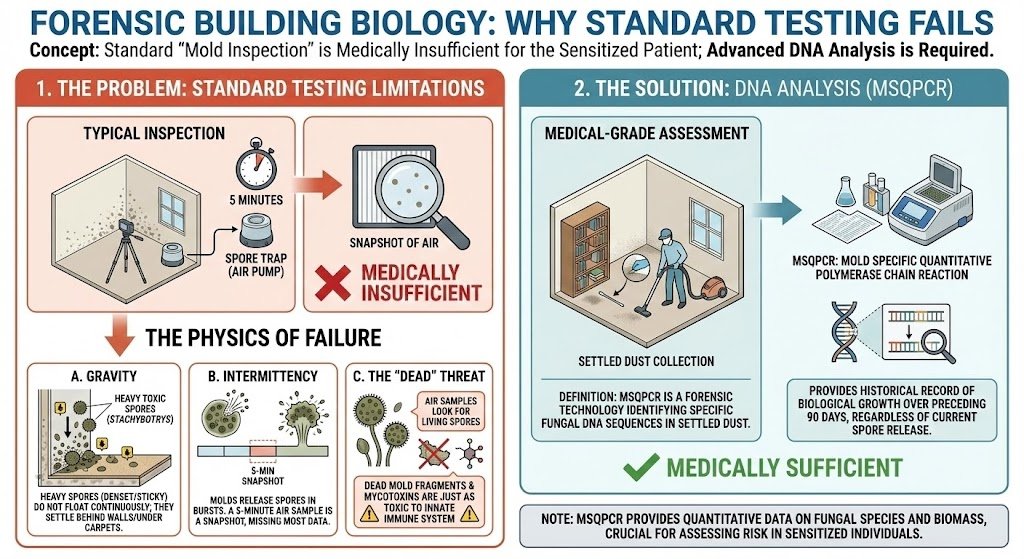
The standard "mold inspection" is often medically insufficient for the sensitized patient. A typical inspection involves setting up a spore trap (air pump) on a tripod for 5 minutes. If no spores are captured, the home is declared "safe."
The Physics of Failure:
Gravity: Heavy toxic spores (like Stachybotrys) are sticky and dense. They do not float continuously; they settle behind walls and under carpets.
Intermittency: Molds release spores in bursts. A 5-minute air sample is a snapshot of a movie. It misses the vast majority of the data.
The "Dead" Threat: Air samples look for living spores. However, dead mold fragments and mycotoxins are just as toxic to the innate immune system.
The Solution: DNA Analysis (MSQPCR) To obtain a medical-grade assessment, advanced protocols utilize Mold Specific Quantitative Polymerase Chain Reaction (MSQPCR). Definition:MSQPCR is a forensic technology that identifies specific fungal DNA sequences in settled dust, providing a historical record of biological growth over the preceding 90 days, regardless of whether the mold is currently releasing spores.
THE METRICS: DECODING ERMI & HERTSMI-2
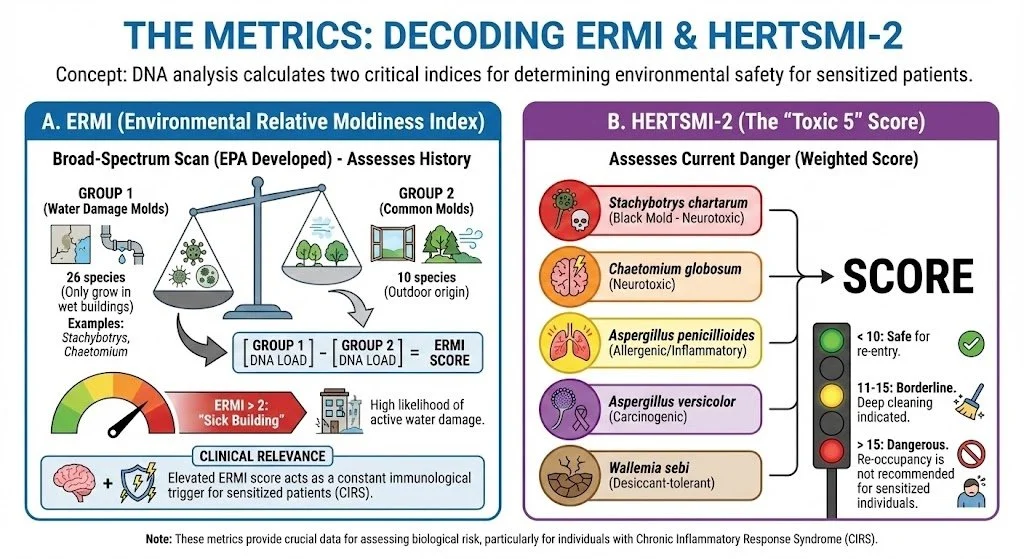
When DNA analysis is performed, two specific indices are calculated. Understanding these values is critical for determining the safety of an environment.
A. ERMI (Environmental Relative Moldiness Index)
The ERMI is a broad-spectrum scan developed by the EPA. It compares the DNA load of two groups of mold:
Group 1 (The Water Damage Molds): 26 species that only grow in wet buildings (e.g., Stachybotrys, Chaetomium).
Group 2 (The Common Molds): 10 species that originate from the outdoors.
The Calculation: Group 2 is subtracted from Group 1.
ERMI > 2: Suggests a "Sick Building." High likelihood of active water damage.
Clinical Relevance: For the sensitized patient (CIRS), an elevated ERMI score acts as a constant immunological trigger.
B. HERTSMI-2 (The "Toxic 5" Score)
While ERMI assesses history, HERTSMI-2 assesses Current Danger. It assigns a weighted score to the five most dangerous molds known to cause human disease:
Stachybotrys chartarum (Black Mold - Neurotoxic)
Chaetomium globosum (Neurotoxic)
Aspergillus penicillioides (Allergenic/Inflammatory)
Aspergillus versicolor (Carcinogenic)
Wallemia sebi (Desiccant-tolerant)
The Score Breakdown:
< 10: Safe for re-entry.
11-15: Borderline. Deep cleaning indicated.
> 15:Dangerous. Re-occupancy is not recommended for sensitized individuals.
THE CLINICAL CORRELATION: DOSE AND SEVERITY
The level of toxicity in the environment directly correlates with the severity of illness in the patient. This is a dose-response curve.
The "Tipping Point": Many individuals live in a water-damaged home for years with minor symptoms. However, once the "Toxic Load" exceeds the body's "Detox Capacity" (often due to stress, viral infection, or trauma), a systemic crash occurs.
The Recirculation Loop: In the 25% of the population with the HLA-DR Genetic Mutation, the body cannot "tag" these toxins for removal. When exposed to a high-ERMI environment, the toxins bio-accumulate.
Low Exposure: Brain fog, fatigue.
High Exposure: Seizures, POTS, autoimmunity, psychosis.
PATIENT RESOURCES: WHERE TO START IN MINNESOTA
Finding a qualified environmental professional is critical. You need someone who understands "Building Biology," not just standard inspection.
Recommended Local & Regional Resources:
Institute for Building Biology & Ecology (Local Chapter): Certified Building Biologists (BBEC) who assess the root cause of the sick building.
EnviroBiotics (DIY Testing): Direct-to-consumer ERMI and HERTSMI-2 dust cloth kits.
Indoor Science / Local Industrial Hygienists: Look for firms that specify "Hygienist" rather than just "Inspector."
FREQUENTLY ASKED QUESTIONS (FAQ)
Answers to the most common questions about environmental toxicity.
Is mold illness actually real?Yes. It is medically defined as Chronic Inflammatory Response Syndrome (CIRS). It is a measurable, multi-system illness caused by the innate immune system's reaction to biotoxins. It is validated by biomarkers such as C4a, MMP-9, and TGF-Beta-1.
Why did my air test come back "normal" if I feel sick?Air tests are unreliable. They only catch spores that are currently floating in the air. Heavy, toxic spores (like Stachybotrys) settle behind walls and in carpets. You likely have hidden mold that a 5-minute air pump missed. We recommend DNA dust testing (ERMI) for accuracy.
Can mold cause brain fog and anxiety?Yes. Mycotoxins are lipophilic (fat-loving) and neurotoxic. They cross the blood-brain barrier and dissolve into the myelin sheaths of neurons, causing neuro-inflammation. This manifests clinically as "Brain Fog," word-finding difficulties, and severe anxiety.
Is bleach effective for killing mold?No.Bleach often bleaches the color but does not kill the root (hyphae) on porous surfaces like drywall or wood. Worse, the chemical stress can cause the mold to release more mycotoxins as a defense mechanism. Removal, not bleaching, is the standard.
PHYSICS BEFORE PHARMACOLOGY
Healing cannot occur in the same environment that caused the illness. If a patient is treated for thyroid dysfunction, gut dysbiosis, or cognitive decline, but continues to sleep in a highly toxic environment, the medical intervention is akin to bailing water on a sinking ship.
Forensic Environmental Assessment is not merely an inspection; for the chronic patient, it is a critical diagnostic step.
Clean Air is the First Prescription.
HYPERCHARGE IS HOPE
While the environment is the trigger, the damage it leaves behind—the mitochondrial fatigue, the inflammation, the brain fog—is biological. And biology can be repaired.
Once the source is identified and addressed, the body requires support to clear the wreckage. HyperCharge Health specializes in the recovery phase. We utilize advanced biophysics to support detoxification, recharge cellular energy, and downregulate the inflammatory storm caused by exposure.
If you suspect your environment is affecting your health, do not guess. Test your home. Then, come to us to test your body.
SCIENTIFIC BIBLIOGRAPHY
Park, J. H., & Cox-Ganser, J. M. (2011). "Mold exposure and respiratory health in damp indoor environments." Frontiers in Bioscience, E3, 757-771. (NIOSH/EPA data on 50% water damage prevalence).
Insurance Information Institute. (2022). "Facts + Statistics: Homeowners and renters insurance." (Data confirming 14,000 daily water damage emergencies).
Vesper, S., et al. (2007). "Development of an Environmental Relative Moldiness Index (ERMI) for US Homes." Journal of Occupational and Environmental Medicine, 49(8), 829-833. (The seminal paper on MSQPCR and ERMI).
Shoemaker, R. C., & House, D. (2006). "Sick building syndrome (SBS) and exposure to water-damaged buildings: time series study, clinical trial and mechanisms." Neurotoxicology and Teratology, 28(5), 573-588. (Foundational CIRS paper).
Hope, J. (2013). "A review of the mechanism of injury and treatment approaches for illness resulting from exposure to water-damaged buildings, mold, and mycotoxins." The Scientific World Journal.
Rosenblum Lichtenstein, J. H., et al. (2015). "Repeated mouse lung exposures to Stachybotrys chartarum shift immune response from type 1 to type 2." American Journal of Respiratory Cell and Molecular Biology.
Bloom, E., et al. (2009). "Mass spectrometry-based strategy for direct detection and quantification of aflatoxins in dust from water-damaged buildings." Applied and Environmental Microbiology.
ABOUT THE AUTHOR
Dr. Stefano Sinicropi, MD is the Founder of HyperCharge Health and a global thought leader in the emerging field of Human Engineering. A Board-Certified Spine Surgeon by training, Dr. Sinicropi is dismantling the "Silo Model" of modern medicine by integrating Quantum Biology, Physics, and Molecular Engineering into clinical practice.
His approach is forged from 20 years of experience treating tens of thousands of patients struggling with chronic pain and spinal pathology. Witnessing the despair caused by systemic inflammation and metabolic failure, he has pivoted his clinical focus to solving the root causes of chronic illness. He applies a forensic, engineering mindset to the "invisible" epidemics of our time—from Mold Toxicity to Autoimmunity—translating elite surgical precision into the management of complex, systemic disease.
He serves as Co-Chair of the Spine Division for the Society for Brain Mapping & Therapeutics (SBMT) and is the author of Wellness at the Speed of Light.